Table of Contents ▾
Understanding piercing gauge sizes is the first step toward choosing body jewelry that fits correctly. Gauge refers to the thickness of the part that passes through the piercing, not the length of a post or the diameter of a ring. The numbering also works in reverse: 16g jewelry is thicker than 18g jewelry, while 14g is thicker than both.
Gauge alone does not determine whether a piece will fit. You must also consider wearable length, internal diameter, jewelry style, placement, anatomy, and whether the piercing is fresh or fully healed. Two people with the same type of piercing may need different dimensions.
The charts and ranges below are useful references, but a professional piercer should measure jewelry when the size is uncertain, the piercing is still healing, or the area is irritated.
Quick Guide to Gauge Numbers
A higher gauge number indicates thinner jewelry. As the number decreases, the jewelry becomes thicker:
- 20g is thinner than 18g.
- 18g is thinner than 16g.
- 16g is thinner than 14g.
- 8g is thinner than 6g.
- 0g is smaller than 00g.
After 00g, jewelry is usually labeled directly in millimeters or fractions of an inch rather than continuing with gauge numbers.
Piercing Gauge Size Chart
Body jewelry measurements are often rounded to convenient metric sizes. Manufacturers may therefore list slightly different equivalents, particularly for 10g, 8g, and 00g. When shopping, compare the exact millimeter measurement rather than relying only on the gauge label.
| Gauge | Common Metric Size | Approximate Inch Size |
|---|---|---|
| 22g | 0.6 mm | 0.024 in |
| 20g | 0.8 mm | 0.031 in |
| 18g | 1.0 mm | 0.039 in |
| 16g | 1.2 mm | 0.047 in |
| 14g | 1.6 mm | 0.063 in |
| 12g | 2.0 mm | 0.079 in |
| 10g | 2.4 to 2.5 mm | 0.094 to 0.098 in |
| 8g | 3.0 to 3.2 mm | 0.118 to 0.126 in |
| 6g | 4.0 mm | 0.157 in |
| 4g | 5.0 mm | 0.197 in |
| 2g | 6.0 mm | 0.236 in |
| 1g | 7.0 mm | 0.276 in |
| 0g | 8.0 mm | 0.315 in |
| 00g | 9.0 to 10.0 mm | 0.354 to 0.394 in |
| 7/16 in | 11 mm | 0.438 in |
| 1/2 in | 12 to 13 mm | 0.5 in |
| 9/16 in | 14 mm | 0.563 in |
| 5/8 in | 16 mm | 0.625 in |
| 3/4 in | 19 mm | 0.75 in |
| 1 in | 25 to 25.4 mm | 1 in |
The variation at 00g is particularly important. Some brands label 9 mm jewelry as 00g, while others use 10 mm. Never assume that two pieces marked 00g are identical.
Why Does a Smaller Gauge Number Mean Thicker Jewelry?
The gauge system used for body jewelry developed from systems originally used to categorize industrial wire thickness. More passes through a drawing die were required to stretch a wire into a thinner form, which led to thinner wire receiving a higher number.
Body jewelry retained this reverse numbering pattern. As a result, moving from 18g to 16g means increasing thickness even though the printed number becomes smaller.
This pattern continues until 0g and 00g. Larger stretched-jewelry sizes are easier to compare in millimeters because metric measurements increase normally. A 12 mm plug is clearly larger than a 10 mm plug.
Gauge Is Only One Part of Jewelry Fit
Correctly matching the gauge does not guarantee that a piece will be comfortable. Several measurements work together:
Wearable Length
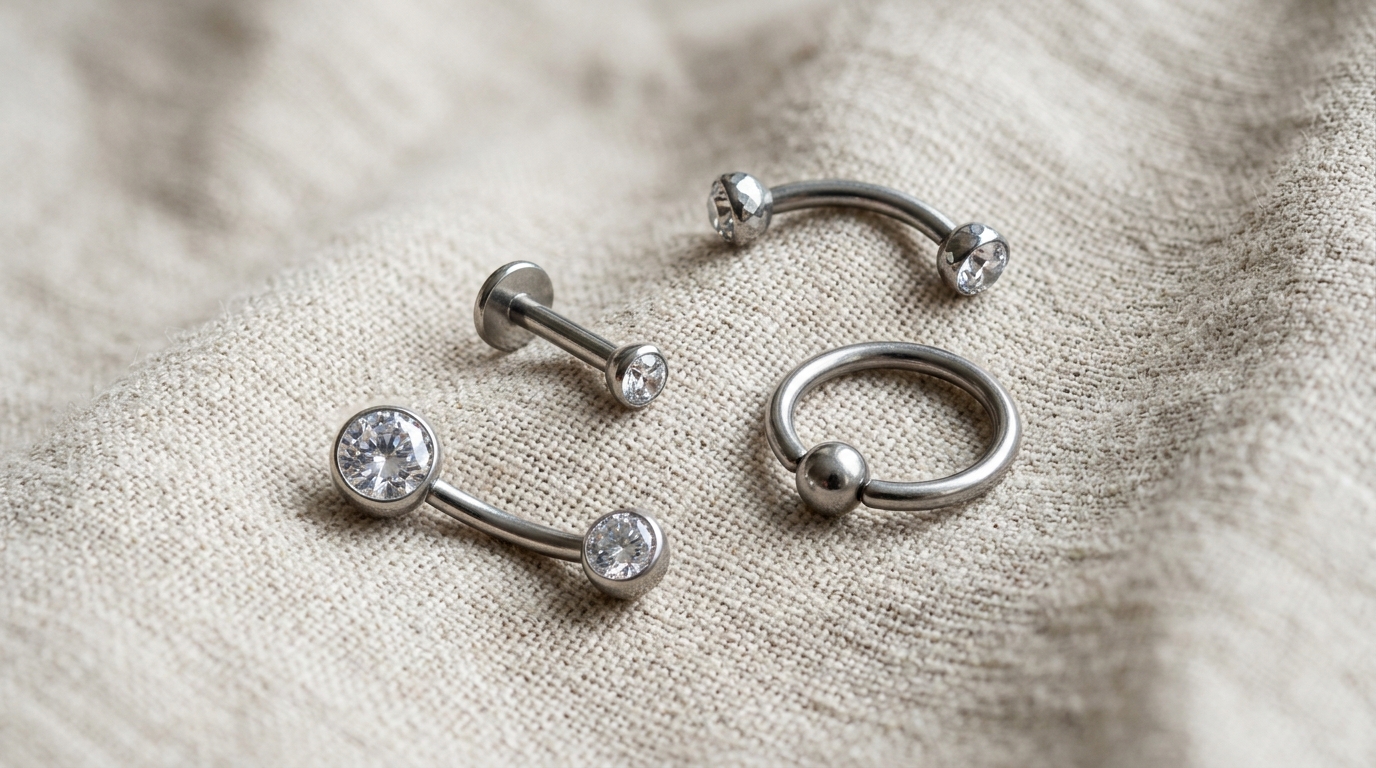
For a straight barbell or labret post, wearable length is the space between the two ends. Decorative tops, balls, and backing discs are not normally included. A post that is too short may press into the skin or become embedded during swelling. One that is too long can move excessively, catch on clothing, and place extra pressure on the piercing.
Internal Diameter
Rings and circular barbells are generally measured across the inside of the circle. The external diameter includes the jewelry’s thickness and does not describe the space available for tissue. A ring that is too small may pull on the piercing channel. An oversized ring may move and snag more than necessary.
Wearable Area on Plugs
For plugs and tunnels, wearable area refers to the section that sits inside the piercing. Flare diameter is a separate measurement. A double-flare plug must have a flare that can pass through the healed opening without being forced.
Common Gauge Ranges by Piercing Placement
The following values are general ranges commonly encountered in body jewelry. They are not universal starter sizes or personalized recommendations. A piercer may choose another gauge based on anatomy, placement, jewelry style, stability, and healing needs.
| Piercing Placement | Commonly Encountered Gauge Range |
|---|---|
| Standard lobe | 20g to 16g |
| Helix and other cartilage | 18g to 16g |
| Tragus | 18g to 16g |
| Conch | 16g to 14g |
| Industrial | Often 14g |
| Nostril | 20g to 18g |
| Septum | 16g to 14g |
| Eyebrow | Often 16g |
| Lip or labret | 16g to 14g |
| Tongue | Often 14g |
| Navel | Often 14g |
| Nipple | 14g to 12g |
There is no single standard nose piercing gauge for everyone. Nostril jewelry is frequently available in 20g and 18g, while some piercers use 16g. Septum jewelry is commonly thicker and should not be treated as interchangeable with nostril jewelry.
Your current jewelry is a better starting point than a generic placement chart. If you do not know its measurements, ask a piercer to identify them before ordering a replacement.
How to Measure Body Jewelry
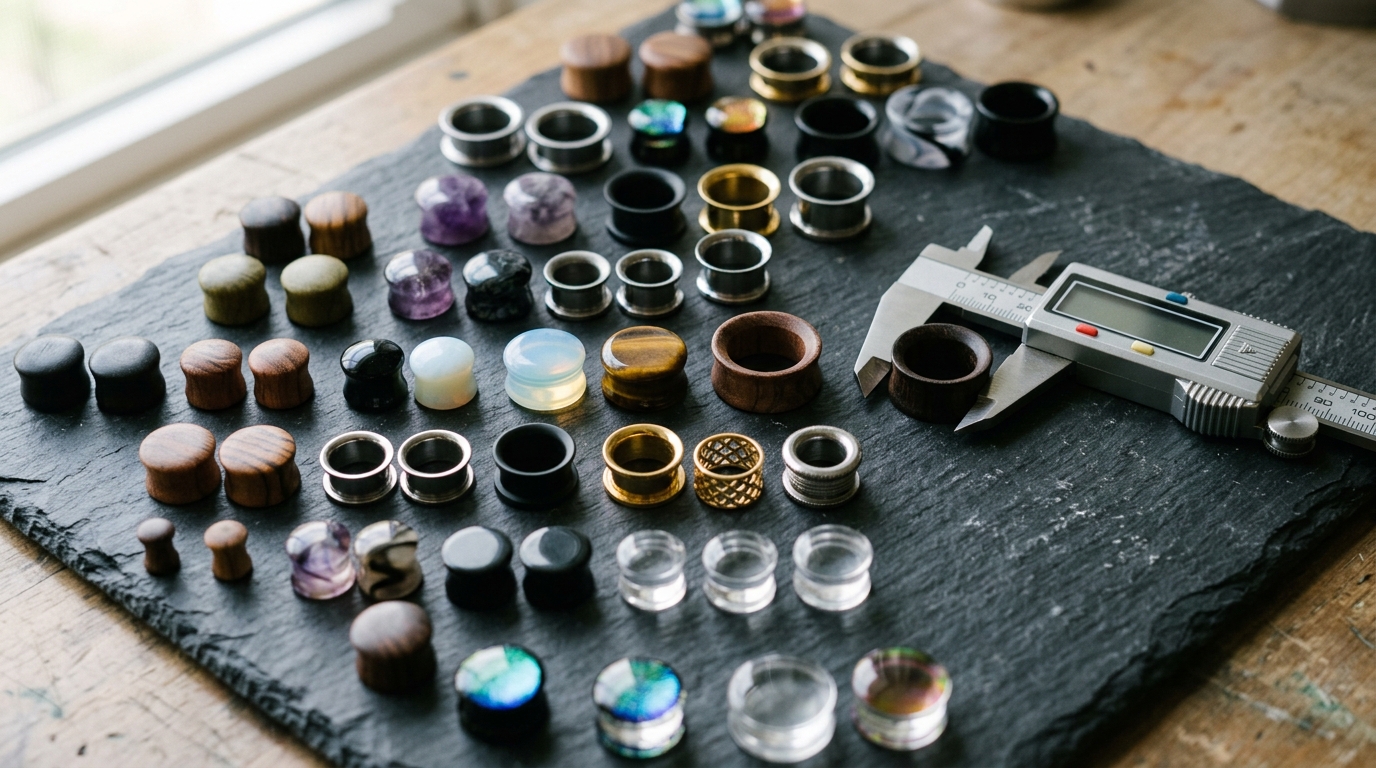
A digital caliper provides a more reliable measurement than a household ruler, especially for differences as small as 0.2 mm. A body-jewelry gauge wheel or sizing card can also help identify post thickness.
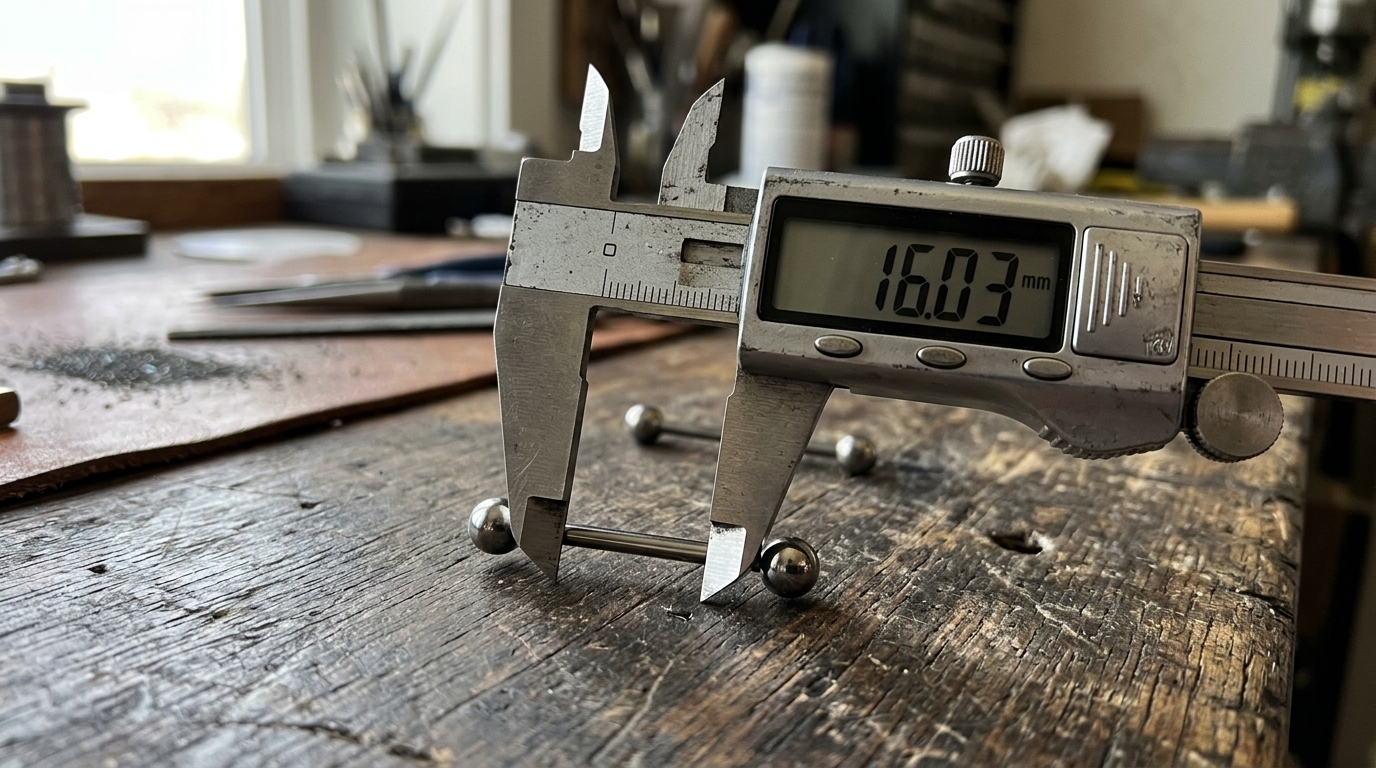
Clean the tool and jewelry before measuring. Do not remove jewelry from a fresh or unstable piercing simply to check its size.
Measuring a Straight Post or Barbell
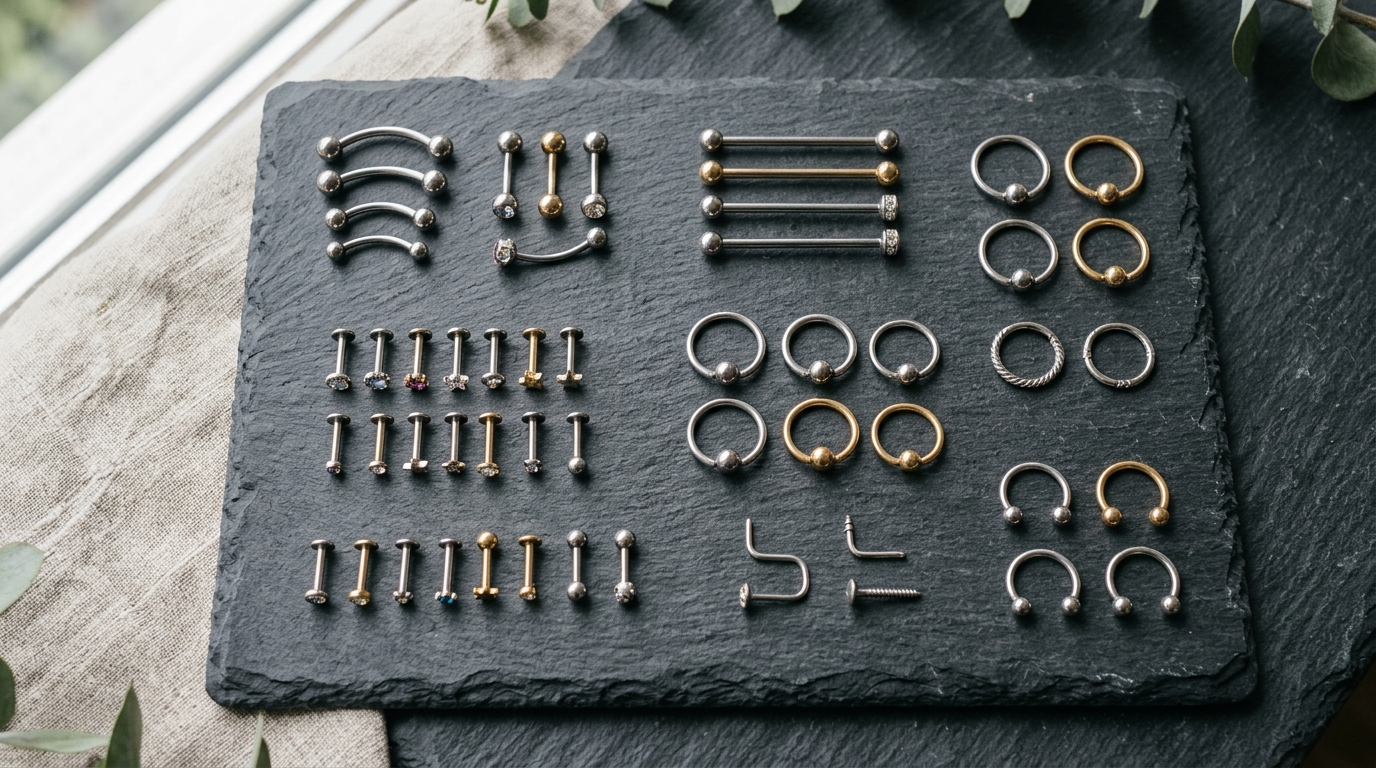
Measure the thickness of the shaft to find its gauge. Measure the wearable section between the ends to find its length. Do not include threaded ends, balls, gems, or a labret’s backing disc.
Measuring a Curved Barbell
Measure the shaft thickness for the gauge. For length, measure the usable section between the inside edges of the end pieces in a direct line rather than following the curve around its outside.
Measuring a Ring
Measure the thickness of the ring itself to find the gauge. Measure straight across the open interior to find its internal diameter. Do not use the outside edge of the ring.
Measuring Plugs and Tunnels
Measure the section worn inside the piercing for the plug size. Also check wearable area and flare diameter. Confirm the exact millimeter size because neighboring stretched sizes may share inconsistent gauge labels.
Choosing Replacement Jewelry
Start with the exact dimensions of the jewelry currently fitting the piercing, but consider whether that piece was intended for initial healing.
Starter jewelry is often longer to allow room for swelling. Once swelling has settled, a piercer may recommend downsizing to a shorter post. Downsizing changes the length, not necessarily the gauge.
Before buying a replacement, confirm:
- Post or ring thickness (gauge & mm)
- Wearable length or internal diameter
- Jewelry style (straight barbell, labret, clicker, curved barbell)
- Threading (internal) or threadless compatibility
- End size and decorative clearance
- Material and polish finish
- Whether the piercing fistula is mature and fully healed
Threaded ends are not universally interchangeable. Thread pattern, post gauge, and manufacturer specifications must match. Threadless ends also require a compatible post. Do not force jewelry that feels too thick or stops during insertion.
What Happens When the Gauge Is Wrong?
Jewelry that is thinner than the established channel may allow the piercing to shrink around it. In some placements, very thin jewelry can place pressure on a narrow area of tissue and contribute to migration or a “cheese-wire” cutting effect.
Thicker jewelry will not fit safely unless the channel already accommodates it. Forcing it through is effectively an uncontrolled stretch and may damage the tissue.
Gauge is not the only possible sizing problem. Jewelry may also be too short, too long, too small in ring diameter, too large and excessively mobile, or incorrectly shaped for your anatomy.
Gauge Sizes and Ear Stretching
Stretching means gradually enlarging a well-healed piercing to accept thicker jewelry. It should not involve forcing jewelry through resistance.
Gauge-number jumps are not equal in millimeters. The move from 14g to 12g (0.4 mm change) is much smaller than the move from 2g to 0g (2.0 mm change). For this reason, millimeter sizing becomes increasingly useful as the piercing grows.
A professional piercer can assess tissue condition and suggest an appropriate next size. Half sizes, such as 7 mm or 9 mm, can reduce large jumps between common gauge labels.
Jewelry Quality Matters Alongside Size
Even perfectly sized jewelry can cause trouble if its material, construction, or surface finish is unsuitable.
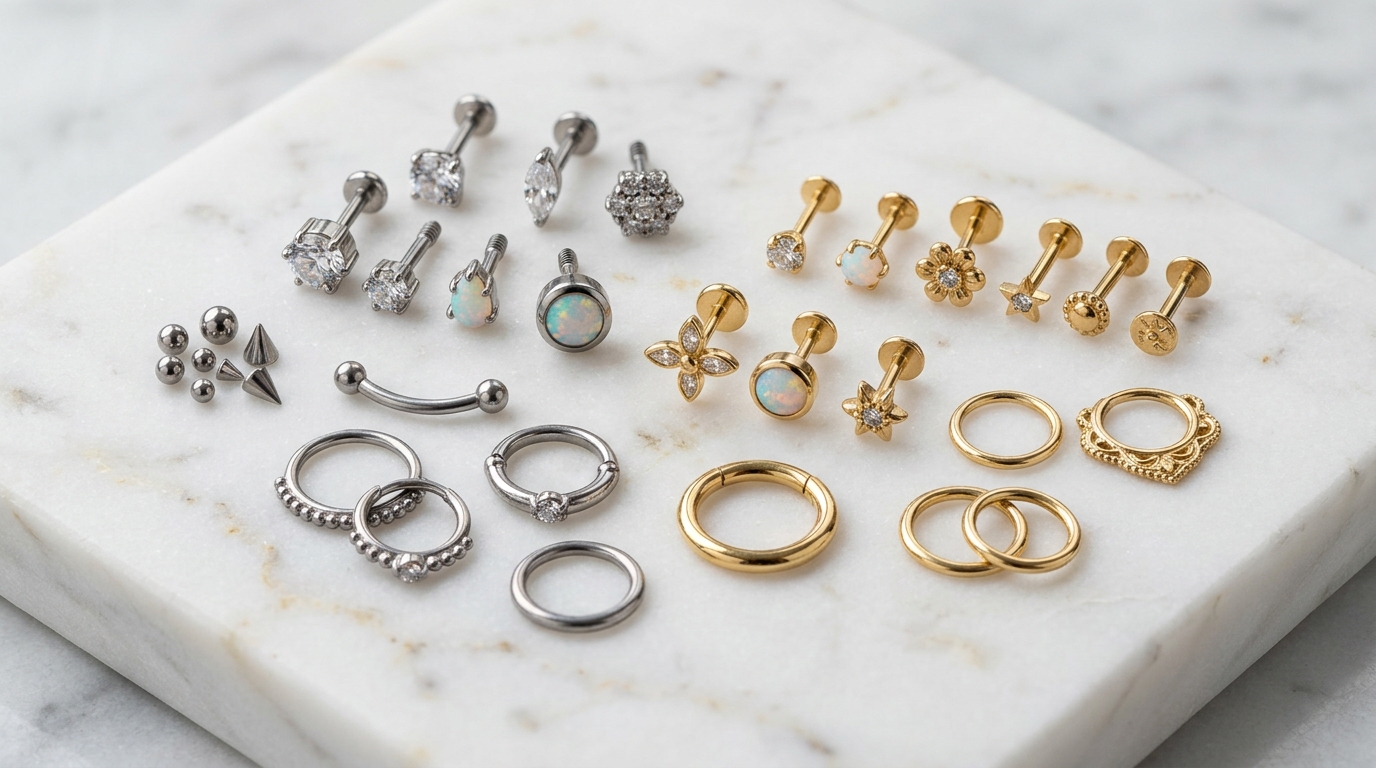
Initial jewelry should be smooth, properly finished, compatible with the body, and capable of appropriate sterilization. Common professionally used options include documented implant-grade titanium, specific biocompatible steel grades, niobium, appropriate solid gold, and lead-free glass.
Frequently Asked Questions
What are the most common piercing gauge sizes?
Many body piercings use jewelry between 20g and 14g. Nostril and lobe jewelry is often toward the thinner end, while tongue, navel, and nipple jewelry is commonly thicker. These are broad ranges, and the correct size depends on the original piercing and individual anatomy.
Is 16g thicker than 18g?
Yes. Gauge numbers work in reverse, so 16g is thicker than 18g. A nominal 16g post is about 1.2 mm thick, while 18g is about 1.0 mm.
What gauge is a standard earring?
Conventional fashion earrings are commonly around 20g to 18g, but there is no universal measurement. Professionally placed lobe piercings may use 18g or 16g jewelry. Measure the existing post or ask a piercer before purchasing body jewelry.
How many millimeters is 0g?
A 0g piercing is commonly treated as 8 mm. The next widely sold label, 00g, may refer to either 9 mm or 10 mm depending on the manufacturer. Exact metric measurements are more reliable for stretched jewelry.
Can I put 16g jewelry in an 18g piercing?
A 16g post is thicker than an 18g post. It should not be forced into an 18g channel. If the piercing is healed and you want a larger size, ask a piercer whether a controlled stretch is appropriate.
How do I know whether my jewelry is too tight?
Warning signs include persistent pressure, swelling without space around the jewelry, ends sinking into the skin, or a ring pulling firmly against the channel. Initial jewelry requires room for swelling, while healed jewelry should fit without compressing tissue.
Are gauge and jewelry length the same measurement?
No. Gauge describes shaft thickness. Length describes the wearable portion of a post or barbell, while diameter describes the internal space in a ring. All of these measurements may be needed for a proper fit.
Choose Measurements, Not Assumptions
Correct piercing gauge sizes cannot be selected from placement alone. Confirm the thickness, wearable length or internal diameter, jewelry style, and exact metric measurement before changing a piece. When the piercing is fresh, irritated, stretched, or difficult to measure, professional assessment is safer than testing jewelry by force.
Technical Measurement & Sizing Specialists
Gauge to MM provides calibrated measurement conversion charts and calculation standards for electrical, manufacturing, and body jewelry dimensions.